

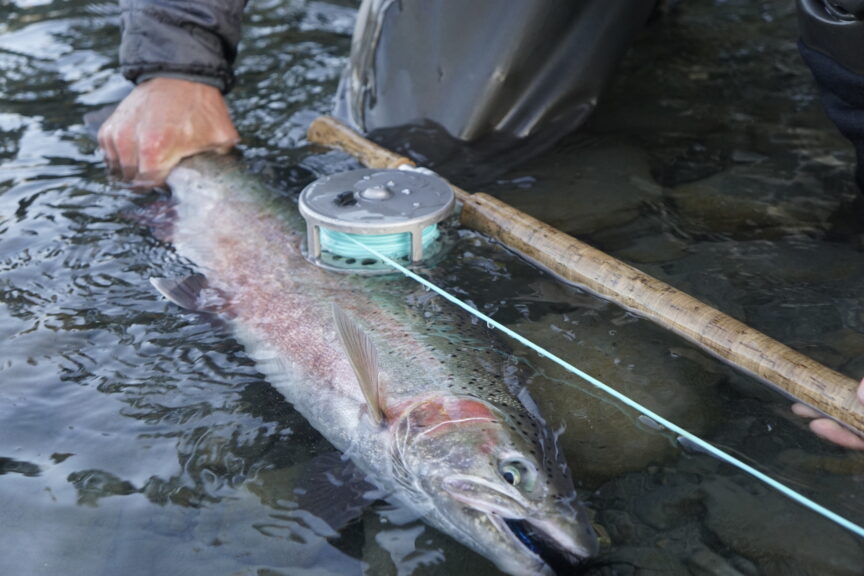
An extensive new study from British Columbia provides important insights into how anglers keep catching fish at normal rates when steelhead runs decline
Back in 2020, we reported on the concept of “hyperstability” and how it could influence steelhead fisheries and management.
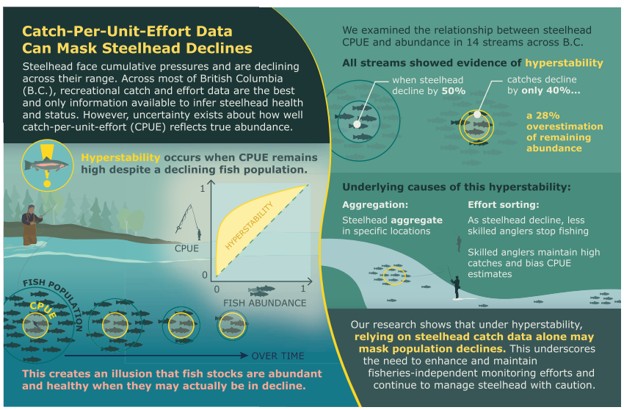
Hyperstability occurs when catch rates in a fishery remain high even when the overall fish abundance declines.
This phenomenon can be dangerous for anglers and managers alike, because it means catch rates might not give an accurate impression of the number of returning fish. Put another way, it means that just because skilled anglers are still catching fish, it doesn’t mean that there are necessarily a lot of fish around.
By masking fish population declines (and contributing to the collective experience of shifting baselines), hyperstability can prevent managers and anglers from supporting actions required to rebuild fish numbers or prevent further declines.
New research focused on steelhead
When we originally reported on hyperstability, our example was based on a study focused on largemouth bass in a Wisconsin lake. Since then, a team of researchers led by Julie Charbonnea published a 2025 study showing a similar pattern when they looked closely at British Columbia recreational steelhead fisheries.
To assess whether hyperstability was at play, the researchers used a dataset spanning from 1972 to 2019 to evaluate the relationship between angler catch rates and steelhead abundance in fourteen streams across British Columbia.
Consistently across all fourteen fisheries, they found that angler catch per unit effort (i.e., the number of fish caught per day of trying) did not fall as rapidly as population abundance had, a clear pattern of hyperstability across a wide range of streams and fisheries.
On average they found that when a steelhead population had declined by 50%, catch rates only declined by 40%. This means that if managers assumed there was a 1:1 relationship between angler catch rates and population abundance, steelhead numbers would be overestimated by 28%.
Based on the relationship observed in the data, the effects of hyperstability are even more drastic as fish populations continue to decline. When the researchers simulated a 90% decline in abundance, they found that catch rates only declined by 77%, which would lead to a 109% overestimation of steelhead returns during these years of critical conservation concern.
Potential causes of hyperstability in a fishery
The authors suggest two mechanisms leading to hyperstability: aggregation of fish in the rivers and angler effort sorting.
The first of these concepts – aggregation – shouldn’t come as a surprise to anglers who spend a lot of time on the water. On any river, there are those favorite holes or runs that just always seem to produce fish. They are the best locations for fish to use year after year, so no matter how many resident fish live in a stream or how many migratory fish arrive, they are most likely to be found in those primary spots first.
Anglers who learn those key locations where fish aggregate can still find fish, even when total abundance numbers in the system are low and secondary locations aren’t productive.
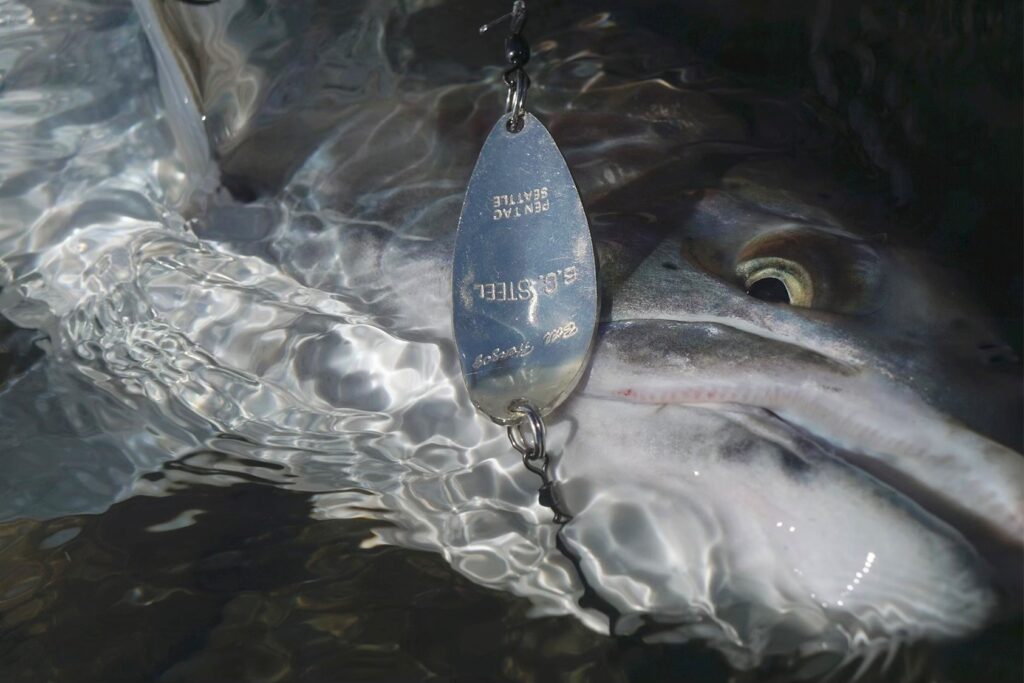
Image: Lee Geist
Whether there are just a few fish in the pool, or it is packed with fish, you typically will only catch a few fish before the rest of the fish spook or get much more challenging to entice to bite.
This point was really driven home to me while doing hook-and-line sampling for juvenile steelhead and resident rainbow trout on the Olympic Peninsula. After sampling a productive run and catching a few fish, I put a snorkel mask on and poked my head under the surface only to see the 25 fish that had refused to take any offerings after a few of their brethren had been caught.
This helps explain how hyperstability influences the perception of fish numbers and the risks of outsized angler impacts.
While there were 25 fish in that hole during a high abundance year, during low abundance years that number might reduce to ten fish. Under this scenario an angler would likely catch the same number of fish (let’s say 5 in this scenario) before the rest of the fish in the pool got spooked and refused to bite. As a result, the angler’s impact on the fish would shift from 20% during the high abundance year to 50% during the low abundance year.
Because the angler caught about the same number of fish from the pool, this could easily leave the angler with the impression that there were still just as many fish around during low abundance years.
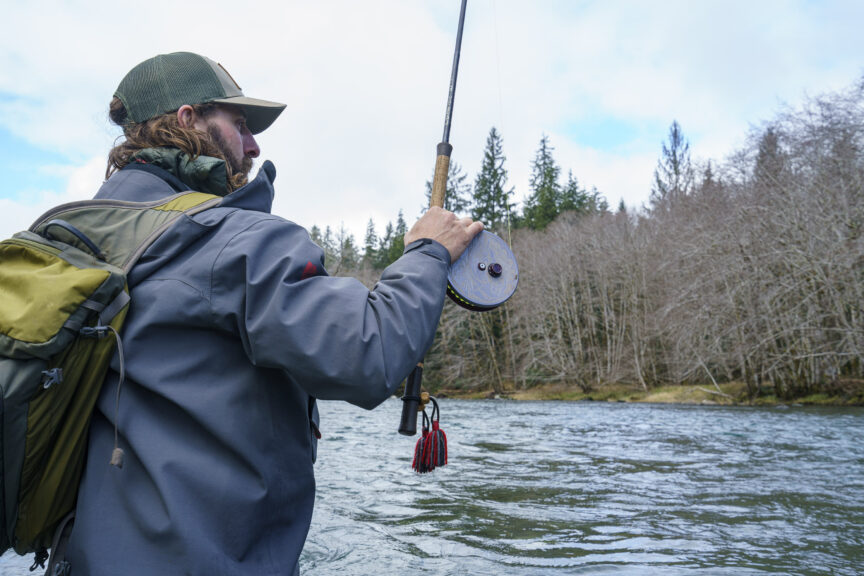
Image: Lee Geist
Effort sorting, on the other hand, has to do with how angler skill levels impact catch rates and participation in the fishery.
For steelhead anglers that are just starting out or are new to a river, low abundance years can be particularly challenging as fish are spread thinner throughout the system. Without local knowledge of where fish aggregate, or specific angling skills, those less experienced anglers are less likely to catch a fish.
This lack of success can lead these anglers to stop fishing. Anglers with more local knowledge and/or more skills keep fishing and are able to maintain relatively high catch rates despite fewer numbers of fish being in the river because they know the best water to fish and the techniques that work well. Less experienced anglers may also be more likely to turn to guides when fishing is challenging. Guides are usually among the most skilled and knowledgeable anglers on any given river system. They utilize their experience to help less skilled anglers catch fish they might have not been otherwise able to find.
So why is recognizing hyperstability important?
There are a couple of major reasons why the outcomes of this study are important and should give anglers and fishery managers pause.
First, during periods when runs are weak or experiencing long-term declines, a status quo fishery will be expected to have much higher impact rates on fish than it would during periods of high abundance. As such, managers may need to consider regulation changes to reduce impacts and give fish a better chance to successfully reach their spawning grounds.
Reducing fishery impacts can come in the form of closures or shortened seasons, limits on the number of anglers and guides participating in the fishery, and/or limits on the most effective angling methods.
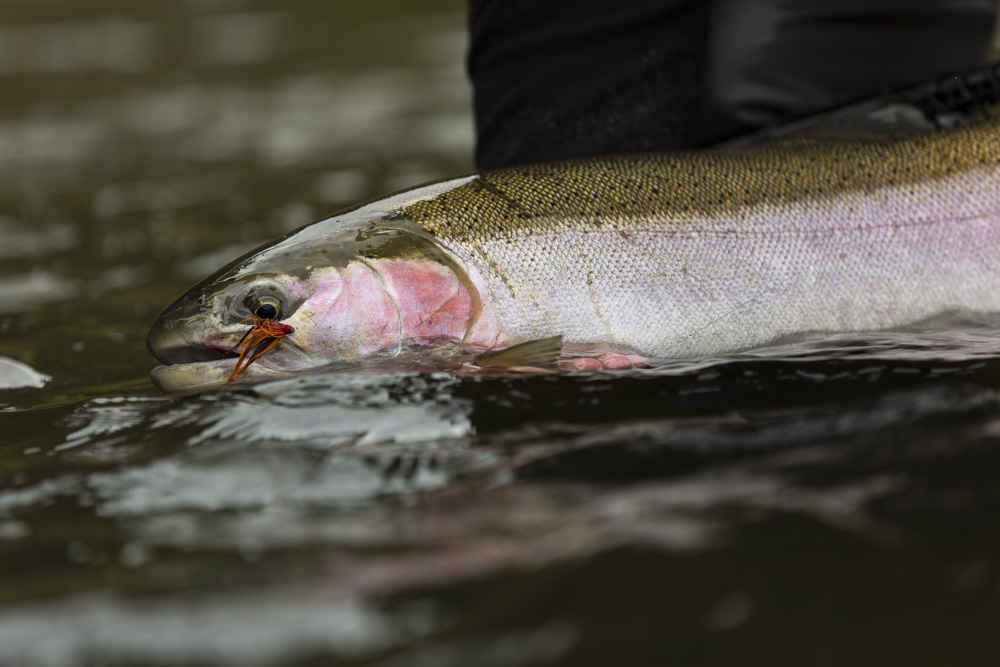
Image: Josh Duplechian
However, without proper data on fish population abundance or robust in-season monitoring, it may be difficult to determine when these regulation changes are necessary or when they would be most effective at reducing impacts to struggling fish numbers.
This brings us to our second point. Steelhead fisheries, especially when they are in decline, need quality forecasts and in-season data. Without investments in both, managers are flying blind and unaware of the extent of impact they are allowing on steelhead populations. Hyperstability helps explain how easy it is to exceed estimated or assumed impacts on returning steelhead.
In these scenarios, overexploitation of fragile stocks is only discovered once it is too late and recovery is (once again) set back. When it happens repeatedly, the impact becomes chronic and contributes to declining steelhead numbers.
The ongoing need for improved forecasting and monitoring
Forecasting run sizes is a challenging endeavor, especially with our changing climate. Fishery management agencies need to continue to invest in ways to improve model accuracy while also evaluating and expanding approaches to collect real-time fish counts during fishing seasons.
Currently, most abundance data is based on redd counts, but these surveys are expensive, challenging and the results are usually not available until after a fishery season has concluded. As such, it may be tempting for managers to look to catch data to serve as a surrogate to monitor the health of steelhead populations in-season. However, as the BC hyperstability study points out, it is important to remember that the relationship between catch rates and population is not 1:1. Especially during low abundance years, relying exclusively on catch data could lead managers to drastically overestimate how well steelhead populations are doing.
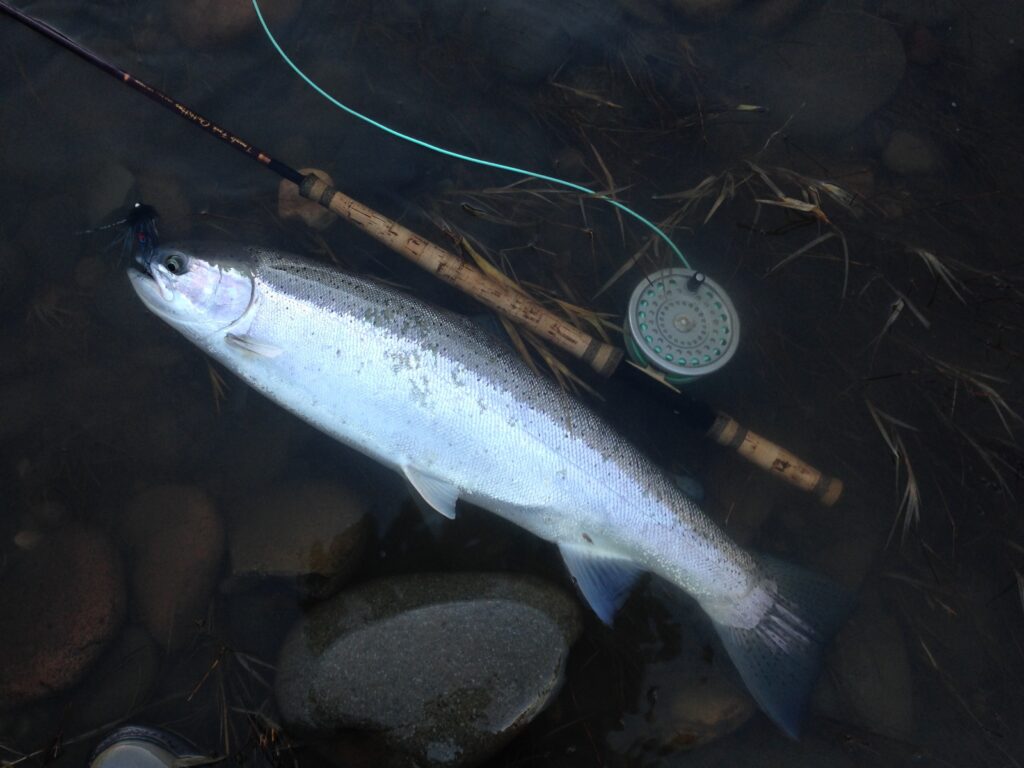
Image: Dean Finnerty
While catch data, such as creel surveys and electronic catch record cards that provide important in-season data, are still essential for determining fisheries impacts, this new research from BC highlights the importance of pairing those approaches with additional real-time monitoring to improve management responses and help support struggling wild steelhead populations.
Sonar is currently one of the leading tools that can be used to provide near real-time abundance data, with but its use for steelhead still remains relatively limited. In Washington, the WDFW is currently using sonar monitoring on the Olympic Peninsula’s Clearwater River to monitor adult steelhead returns in an effort to improve escapement data.
There is a need to expand this work and improve the backend data analysis so that managers have the information they need to make decisions during the fishing season and respond to years in which steelhead numbers drop to critical levels. This is only going to become more important moving forward as we appear to be moving into another period of poor ocean productivity and steelhead returns are becoming increasingly variable from year to year.
For anglers, the lessons from this work are a bit more straightforward and come down to the fact that the catch rates you experience fishing are not necessarily a perfect indicator of the health of the local steelhead population. This is especially true for experienced anglers and guides, whose skill and knowledge are more likely to allow them to find the few fish that are in the river during low abundance years. For managers, this study reinforces the importance of in-season fishery and run size monitoring. Without this crucial information managers run the risk of failing to account for poor returns as the season progresses and thus failing identify the need for conservation actions until after the season has concluded, putting future returns and fisheries in jeopardy.